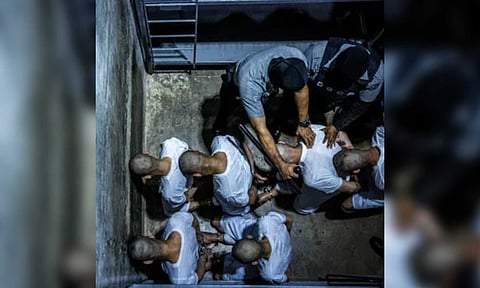

The Trump administration last month deported scores of Venezuelan men to El Salvador, sending them to a maximum-security prison for gang members. The administration claimed that most of the men were members of the Venezuelan gang Tren de Aragua, a group that, according to the executive order decreeing the deportations, is “conducting irregular warfare and undertaking hostile actions against the United States.”
Tren de Aragua is not invading America. While the research organization InSight Crime, which has tracked the gang for years, has found that it does have a limited presence in the US, researchers have seen no evidence that it has organized cells in the country that cooperate, much less receive directions from abroad. The exaggerated government claims and ensuing public concern about the group’s activities in the US amount to a classic moral panic, in which a handful of crimes are cited by politicians as evidence of an urgent threat to society.
To be sure, Tren de Aragua is a dangerous group, responsible for horrendous crimes in Venezuela and elsewhere in South America. The three of us have spent decades studying violence in Venezuela precisely because we understand its ability to destroy lives, families and neighbourhoods. But central to creating a more secure world is getting the facts, causes and solutions right. So far, many American politicians, police officers and journalists have failed to do so, and instead have perpetuated significant misconceptions about Tren de Aragua.
The biggest misconception concerns the group’s organizational capacity. Tren de Aragua was recently designated a terrorist organization by the US, alongside much more established groups like the Mara Salvatrucha in El Salvador and cartels in Mexico. Calling criminal groups terrorists is always a stretch since they usually do not aim at changing government policy.
Organized crime is far less portable than people usually think. It typically involves control of illicit markets, which in turn depends on relationships with local people and officials. These networks are not easily transferable and limit mobility. This is one of the reasons that many criminal groups have geography in their name: Sinaloa, Medellín, Cali and, of course, Aragua, an agricultural state in north-central Venezuela, and home to the Tocorón prison, where Tren de Aragua originated. These names describe their base of operations and the place where they are dominant.
The Trump administration has suggested that Venezuela’s president, Nicolás Maduro, sent members of Tren de Aragua and other Venezuelan gangs to the US to destabilize the country. But in February, US intelligence agencies reportedly circulated findings internally that Tren de Aragua is not controlled by the Maduro government and the gang members who are in the US have not been sent here by it.
A handful of news reports about suspected Tren de Aragua members describe them as responsible for serious crimes in America. Arrests have primarily been for crimes like shoplifting, burglary and cellphone robbery. And of course, other Venezuelan immigrants have also committed crimes in the US; with approximately 770,000 living here as of 2023, sheer numbers make this an inevitability. None of this is evidence of a Tren de Aragua invasion.
Over the past two centuries, the arrival of Irish, Italian, Chinese and Mexican immigrants in America have produced similar moral panics, set off by real problems but also exploited by politicians. Despite President Trump’s constant claims, America is not in the grip of a crime wave — preliminary data from the FBI shows that crime continued to drop last year — and research consistently shows that increases in immigration do not cause increases in crime.
The Trump administration’s deportations of more than 200 Venezuelan men to an inhumane and overcrowded Salvadoran prison will almost certainly help deter migration, but there are ways to curb immigration that do not rely on mass criminalization, arbitrary detention and the violation of due process, all characteristics of the regime many Venezuelans are trying to escape.
None of these initiatives are likely in an administration that seems set on coercive and dissuasive policies. But whatever policies they pursue, immigration officials must respect the rule of law and human rights. The mass criminalization, arbitrary detainment and violation of due process that have characterized the Trump administration’s actions so far have echoed some of the tactics of the Venezuelan regime many of these young men presumably fled from. It reduces U.S. credibility and emboldens authoritarians everywhere.
©️The New York Times Company