
• People living in the United States and using mainly dollars in their personal lives may not fully appreciate the combination of shocks that have unnerved investors elsewhere in the world.
The first half of the year was a game changer for investors in Europe, Japan and many other countries for whom the instability of the US financial markets was a seismic event. After years of US outperformance, stocks, bonds and the dollar all experienced painful reversals that were magnified for those holding euros, yen and other currencies.
In fact, calculations by the global financial services company MSCI show that for people using Japanese yen or euros, the combined volatility of the dollar and the US stock market in the first half of 2025 made US equities even riskier in some respects than traditionally risky emerging markets. That category includes an extraordinarily diverse range of countries, including India, Taiwan, South Korea, Brazil, Mexico, Saudi Arabia and China.
The US stock market has largely rebounded since late April, and that may be masking an unpleasant reality. For global investors, the lagging performance and heightened volatility of US markets this year represent a shift. For most of the last few decades, US financial markets were unquestionably the premier destination, both in terms of relatively high investment returns and low risk.
The advantages of the US remain formidable, and the recent tumult may recede into the background, but because many current problems appear to stem from the policies of the Trump administration, there is ample reason for concern.
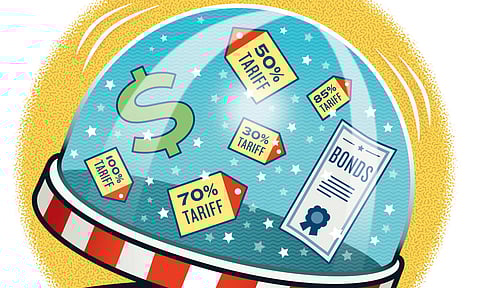
The shudders in US financial markets after Trump’s tariff announcements on April 2 amounted to what Ashley Lester, chief research officer of MSCI, called a rare “triple-red moment,” a simultaneous and significant sell-off of stocks, treasury bonds and the US dollar. Most episodes of triple-market declines have been brief — a big exception being the prolonged market turmoil of the 1970s. In that period, he said, “oil shocks, Vietnam-era deficit spending and a Fed that lacked credibility led to the collapse of the Bretton-Woods system” of fixed exchange rates pegged to the dollar, which was then convertible to gold. The breakdown caused chaos in financial markets, but the US reemerged as the central, indispensable player in global finance.
The markets have reacted more calmly to the latest tariff announcements from Trump, but that may be because of the spreading belief in the TACO meme — “Trump Always Chickens Out” — meaning that he won’t ultimately impose tariff rates as high as he has threatened.
Nonetheless, the effective US tariff rate is already the highest it has been since the Great Depression, according to the Budget Lab at Yale, and many countries have refrained from imposing equivalent tariffs on the US in the hope of reaching a compromise. The perils of this global trade war could still become much worse.
The Trump administration has been intensifying its criticism and pressure on the Federal Reserve and its chair, Jerome Powell, whose independence is widely viewed by economists and investors as crucial for the health of the markets and the overall economy.
The markets won’t shrug off such problems forever.
At a minimum, with shifting projections of investment risk and the furore of the early days of the Trump administration, international investors need to evaluate whether it makes sense to shift some money to countries other than the US. And US investors with a strong home-country bias may want to consider whether they have diversified sufficiently outside the US.
What’s impressive about the US stock and bond markets turning in solid performances for US investors this year is that the markets rebounded despite continual shocks, uncertainty and periodic sharp price declines, often induced by the disruptive policies of the Trump administration. Even so, in terms of market performance, America this year is far from first. Because the dollar fell an average of 10% against other developed-market currencies and 7% against those in emerging markets, the advantages of investing outside the US have been even more compelling for people living elsewhere and using other currencies.
Clearly, an international approach was a good strategy for many people. Generally speaking, diversified holdings in emerging and developed markets outside the US were superior to investments in US assets in the first half of this year.
The critical question is whether that will be true in the future. No one knows the answer, but it’s being asked urgently by global investors.
Perhaps this will be remembered as an odd and troubling moment in the long history of US exceptionalism. Advances in fields like artificial intelligence may supercharge US markets, and the traditional strengths of the US economy and political system may be sufficient to withstand this difficult time.
But it’s possible that, in critical ways for investors, we are already living in a new world.
It makes sense to diversify, even if the US returns unequivocally to its old status as the indispensable country with the most reliable economy and markets in the modern world.
The New York Times Company