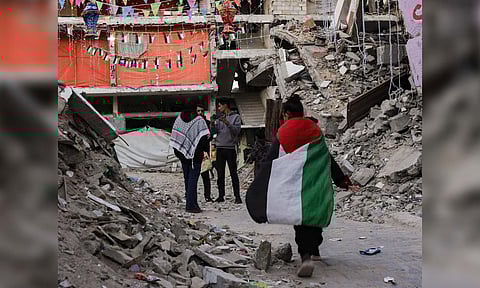

As famine looms in Gaza, the nations of France, Britain and Canada have declared their intent to recognise a Palestinian state. The immediate response from Israel and the US was alarm. Prime Minister Benjamin Netanyahu of Israel labeled such action a “reward” for Hamas, which was responsible for the killing of about 1,200 people in Israel in its Oct. 7, 2023, attack. American officials condemned the planned recognition.
Nevertheless, a new wave of recognition would represent a clear affirmation of Palestinian political independence and territorial integrity — no small matter after decades of diplomatic ambiguity and Israel’s longstanding violation of the Palestinians’ right to self-determination. Given that sovereignty is the currency of international law, the move could provide advocates for Palestinian rights more leverage for pushing their governments to comply with international law regarding Israel.
Already, 147 countries recognise the state of Palestine. The addition of these three Western powers — key Israeli allies — would be a major step, and leave the US more isolated as a major supporter of Israel.
Yet this recognition is far too little and much too late. It is also a radically inadequate response to starvation — let alone genocide, as many human rights groups, genocide and Holocaust studies scholars and UN special rapporteurs have categorised Israel’s actions in Gaza after almost two years of war there. Moreover, it has been shamefully tethered to conditions.
Prime Minister Keir Starmer of Britain framed recognition as a threat: He will recognise Palestine unless Israel takes “substantive steps” toward ending Gaza’s “appalling situation,” agrees to a cease-fire and commits to peace. Prime Minister Mark Carney of Canada made recognition conditional upon Palestinian political reform, Hamas’s exclusion from Palestinian elections and a demilitarised state. Less explicitly issuing a condition, President Emmanuel Macron of France promised recognition while reminding Mahmoud Abbas, the leader of the Palestinian Authority, of his commitments to reform.
Meanwhile, despite widespread consensus that Israel has committed international human rights violations and crimes, Israel faces few restrictions or conditions on the billions of dollars it receives in military aid.
The three nations’ announcements coincided with a UN General Assembly conference last week on a two-state solution hosted by France and Saudi Arabia. The gathering, which included representatives from Canada and Britain, produced what was called the New York Declaration, which laid out steps for a resolution to the conflict. It demands an end to the war in Gaza, immediate humanitarian access, the unification of Gaza and the West Bank, including East Jerusalem, in a Palestinian state and a halt to Israel’s settlement and annexation of Palestinian territory.
The organisers hope a majority of General Assembly members will endorse the plan at their annual meeting in September, and urged all countries that have not done so to recognise the state of Palestine. The declaration has left Israel increasingly alone in the world community. But it also makes clear that the sovereignty game has different rules for different players.
According to the declaration, Palestinians are expected to reject violence, commit to a demilitarised state, maintain a security system beneficial to “all parties,” hold elections and develop “good governance, transparency, financial sustainability” alongside “service provision, business climate and development.” Israel, by contrast, is called upon to obey basic international rules, publicly embrace the two-state solution and withdraw its troops from Gaza.
The decades-old two-state script has scarcely been rewritten for a new age of genocide. In a 1993 exchange of letters, the Palestine Liberation Organisation’s chairman, Yasir Arafat, recognised the “right of the State of Israel to exist in peace and security” and committed the PLO to peaceful negotiations. In return, Israel would merely recognise the PLO as the representative of the Palestinian people — and only “in light of” Arafat’s commitments. Palestinian sovereignty remained remote; Israeli occupation continued apace.
Today, Western governments demand that Palestinians reprise this bureaucratic performance while Israeli officials openly discuss Gaza’s “voluntary emigration” and the permanent annexation of the West Bank.
The states endorsing the New York Declaration and announcing plans for recognition face two immediate tests. First, will they enforce international law with regard to Israel’s most egregious violations on the ground, both in Gaza and the West Bank? These include charges of genocide, crimes against humanity and war crimes. Israel denies those charges as well as the accusation that it is causing starvation in Gaza.
After almost two years of severe access restrictions and the dismantling of the UN-led aid system in favour of a militarised food distribution that has left more than 1,300 Palestinians dead, the 15 nations that agreed to the declaration still would not collectively say “Israel is responsible for starvation in Gaza.” If they cannot name the problem, they can hardly hope to resolve it.
@The New York Times