
Donald Trump’s bombing of Iran’s nuclear facilities is a once-in-a-generation event that could transform the Middle East, US foreign policy, the effort to stop the proliferation of nuclear weapons and potentially the global order. While its full impact will take decades to understand, it raises a more immediate question today: Will this extraordinary act of war strengthen Tehran’s authoritarians or hasten their demise?
The direct origins of the US-Iran conflict date back to the 1979 revolution that replaced Iran’s US-allied monarchy with an anti-American theocracy. Since then the Islamic Republic of Iran has vowed to end US imperialism and eradicate Israel. Now, the US and Israel are waging a military campaign inside Iran with a stated goal of destroying its nuclear capability — though the regime’s collapse, while not the declared objective, would be a welcome outcome for both nations. But while military strikes may expose an authoritarian regime’s weaknesses, they rarely create the conditions necessary for lasting democratic change.
Long before Israel’s invasion and Trump’s strikes, the Islamic Republic resembled a zombie regime, ideologically dead but still repressive, much like the late-stage Soviet Union. Despite the country’s vast human capital and resources, Tehran’s theocrats preside over an economically isolated, socially repressive police state — elbow-deep in corruption and repression, yet ruling from the moral pedestal of an Islamist theocracy. The regime’s enduring slogans, “Death to America” and “Death to Israel” — never “long live Iran” — have long made clear that its priority has always been opposing others, not uplifting its people.
Given its refusal to countenance meaningful political reform, the chasm between Iran’s static regime and its dynamic population has arguably become among the widest of any society in the world. The regime’s ideological rigidity and nuclear ambitions resemble those of North Korea; the aspirations of its people for modernity and prosperity align it more with South Korea. The only way the government has been able to remain in power has been through relentless physical and digital repression.
Today, the regime most likely has the support of less than 20% of society, but up until now, it has maintained a highly armed, organised repressive apparatus willing to kill en masse. By contrast, the regime’s far more numerous opponents are unarmed, unorganised and unwilling to die en masse. The state venerates martyrdom; the larger society aspires to separate mosque and state. This disparity has enabled the regime to brutally quash nationwide uprisings, including the Woman, Life, Freedom protests of 2022 and 2023.
When Iranians awoke last Friday to news that at least a dozen senior Revolutionary Guards commanders and nuclear scientists had been assassinated by Israel — killed in their bunkers and bedrooms with minimal collateral damage — many privately rejoiced. But as Israeli bombs began falling on Tehran, that initial wave of satisfaction gave way to fear, confusion and anger. The capital’s 10 million residents were warned — including by the US president — to flee, even as some were urged by calls from outside Iran to rise against the regime. Independent human rights groups estimate over 300 civilians have been killed in the Israeli strikes.
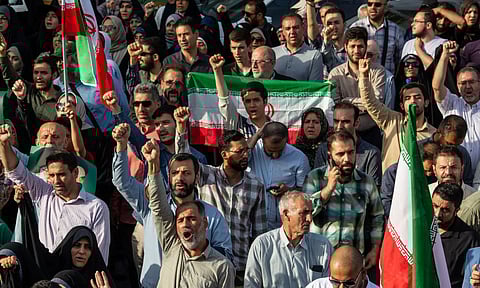
Popular anxiety or outrage over war shouldn’t be mistaken for the Islamic Republic’s political revival. Rather than shift public opinion, Israel’s invasion and the US strikes are in time more likely to amplify existing divides: Loyalists will have more ammunition with which to loathe America and Israel, while critics will see these events as yet another example of how the regime’s ideological obsessions bring disaster to ordinary Iranians.
And yet the twilight of 86-year-old Ayatollah Ali Khamenei’s leadership — and the question of what follows — is fast approaching. Despite most Iranians’ desires to live under a tolerant, representative government that works for their prosperity, authoritarian transitions tend to be brutal contests, not popularity contests, often won by those with the greatest coercive powers. In Iran, it is military men, aspiring Iranian Putins and Sisis and not civilian reformers, who are the best positioned to seize control. According to one study, since World War II, fewer than a quarter of authoritarian collapses have led to democracy — and those brought about by foreign intervention or violence have been even less likely to do so.
There is nothing that says Iran cannot be the exception to this rule. It has all the makings of a Group of 20 nations: an educated, globally connected population, vast natural resources and a proud civilizational identity. The United States and much of the world stand to benefit greatly from the post-Islamic Republic of Iran, which is governed by national interest rather than revolutionary dogma. As Henry Kissinger once observed, “There are few nations in the world with which the United States has less reason to quarrel or more compatible interests than Iran.”
And indeed, many Iranians may have come to yearn for rapprochement with the US. Trump’s decision to drop 30,000-pound bombs on Iran may leave a deep scar on a political culture shaped by historical grievances and collective memory of foreign intervention — most notably the 1953 CIA-led coup against Prime Minister Mohammed Mossadegh, whose mythology has often eclipsed historical fact. Yet America’s postwar relationships with Japan and Vietnam — nations it once devastated — show that even the deepest wounds can heal.
But the most consequential battle for Iran’s future will be fought not between Iran and the outside world, but among Iranians themselves. That struggle is only beginning. Iran’s dynamic, modern population shows there is a light at the end of the tunnel. While outside forces may attempt to blast open the entrance, only Iranian leadership, unity and sacrifice can pave the way through it.
©️The New York Times Company