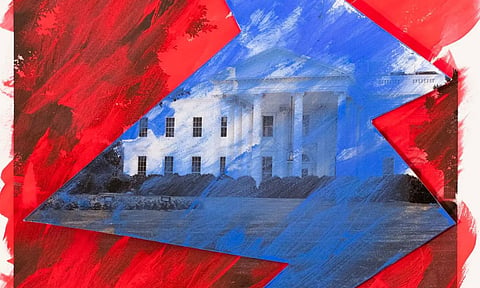

President Trump has claimed a “spectacular military success” in destroying three sites in Iran; we’ll see if that’s true. What is clear is that he has pushed America into a war with Iran that he acknowledges may escalate.
Beyond doubts about the legal basis for bombing Iran, I see risks for America and the world ahead revolving around three fundamental unknowns.
The first uncertainty is how Iran will strike back at the US. Iran’s supreme leader, Ayatollah Ali Khamenei, previously promised, “The harm the US will suffer will definitely be irreparable if they enter this conflict militarily.”
Iran has many options, including attacks on US bases in Iraq, Bahrain and elsewhere in the region. It could also mount cyberattacks, strike US embassies or support terrorist attacks.
Another option would be to seek to close the Strait of Hormuz, fully or partly, by attacking shipping or by laying mines. That could be a blow to the world economy, for one-quarter of the world’s oil passes through the strait. Experts have told me that they believe the US could, over time, reopen the strait, but there might be economic and other costs. When Iran mined the strait in 1988, a mine crippled a US Navy frigate, the Samuel B Roberts.
When the US assassinated Qassem Soleimani, a top Iranian general, in 2020, Iran launched a missile barrage at American bases in Iraq. A Ukrainian passenger jet was hit by accident, killing all 176 people aboard.
My guess is that Iran may want to strike back harder this time, partly to try to reestablish deterrence, but its capacity to do so may be more limited. Israeli strikes might have impaired its ability to mine the strait, for example, and doing so would also impede Iran’s oil shipments to China, annoying its friends in Beijing.
But it’s worth remembering something James Mattis, a defence secretary in Trump’s first term, once said: “No war is over until the enemy says it’s over. We may think it over, but in fact, the enemy gets a vote.”
The second uncertainty is whether the Israeli and American strikes have ended Iran’s nuclear efforts or perhaps even accelerated them. That depends, in part, on whether the bombing of Fordo and other sites was as successful as Trump claimed, and that may take time to figure out.
It was not clear beforehand that even 30,000-pound American bunker busters would be sufficient to destroy the Fordo enrichment site, which is buried deep in a rock mountain. We also don’t know if Iran has other centrifuges in another, unknown site.
There’s broad agreement that a nuclear-armed Iran would be a disaster and would lead other countries in the region to develop their weapon programs. But Tulsi Gabbard, Trump’s director of national intelligence, publicly said this spring that Iran was not building a nuclear weapon; he was dismissive of that.
The risk is that Israeli and American attacks on Iran lead that country to decide it does need nuclear weapons. After all, if it had nuclear weapons, Israel would have been far less likely to bomb it.
Iran has already enriched enough fissile material to a high level for as many as 10 nuclear weapons, according to experts; that material was believed to be in the city of Isfahan. Trump said the US struck Isfahan, but it’s not clear whether the site was destroyed.
The third and final question is the largest: Is this the end of the conflict or the beginning?
Optimists such as Prime Minister Netanyahu of Israel seem to believe that he and the US can end both Iran’s nuclear program and the Iranian regime. Then again, Netanyahu was a strong supporter of the Iraq War and thought that would bring change to Iran as well; instead, the Iraq War benefited Iran.
Even if Iran’s enrichment capacity is gone, the expertise to enrich uranium is probably not possible to extinguish. So if the regime remains, this may be more of a setback than an end to the nuclear program.
As for the idea that bombing will destroy the regime, there’s not much sign of that. Iranian dissidents, like Nobel Peace Prize winner Narges Mohammadi, decried the bombing last week and called on Trump to stop the bombing, not join it.
In my travels in Iran, I’ve seen how unpopular the regime is. Iran — at the popular level — has always struck me as one of the most pro-American countries in the region, precisely because the government is so resented for corruption, hypocrisy and economic incompetence.
That pro-Americanism seemed to bode well for the future, after the death of the supreme leader. But a pro-American government seems less likely if we have waged war on Iran. Indeed, regime change might look more like a hard-line coup than anything else. Once again, the range of possibilities is immense, with some quite alarming.
©️The New York Times Company