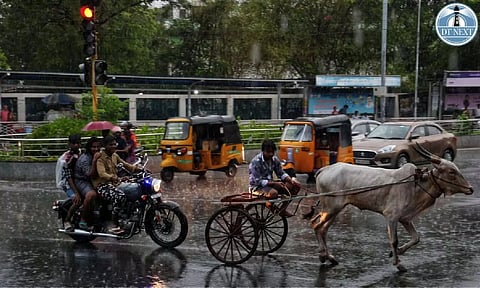

NEW DELHI: This year the southwest monsoon seems to have been in a hurry, arriving a week earlier breaking a 2009 record. It brought along the usual widespread disruption in cities and towns. Whether regular seasonal changes or extreme weather events, India needs to have a robust and reliable weather forecasting system (WFS).
Coincidentally, the government has launched a home-grown state-of-the-art high-resolution system which will be operational from this monsoon season itself. Developed by the Indian Institute of Tropical Meteorology (IITM), Pune, the Bharat Forecast System (BFS) is a technological marvel that the country could be proud of. Its six kilometre spatial resolution is said to be the highest in the world.
Put simply, the BFS can study weather events that occur in a 6 km by 6 km grid as against its predecessor’s 12 km grid – it is somewhat like zooming in without losing clarity. Now BFS can study weather at village(s) level and its equivalent in urban areas and generate accurate localised predictions.
This was made possible by the high-power number crunching supercomputer Arka, which can run a forecasting model in just four hours as against the 10 hours taken by its previous supercomputer Pratyush. Artificial intelligence and machine learning is going to revolutionise WFS too.
European Centre for Medium-Range Weather Forecasts (ECMWF), considered to be industry’s gold standard, and its competitors like Google have been unveiling their AI-ML versions which deliver multiple scenarios, more quickly, and possibly with greater accuracy. Not to be left behind in the race, the BFS too has integrated AI and ML to enhance its forecasts.
With BFS, India is staking claim to be one of the leaders in WFS which is dominated by global players such as ECMWF, an independent, intergovernmental initiative, Google (GenCast), IBM (GRAF) and Accuweather.
After all, weather forecasting is a multi-billion market as accurate predictions can help in increasing revenues and profits in agriculture, aviation, energy, tourism and other weather-sensitive industries and reducing potential losses by taking preventive steps with regard to extreme events and natural disasters. Unlike its global counterparts, India will open up its weather data to researchers worldwide in the spirit of fostering collaboration for greater good.
India has a band of well-known independent, citizen weathermen made popular by social media platforms. They play a crucial role in information dissemination in an easy to understand language. While the Indian Meteorological Department, as an all-India apex body, often prioritises catering to macro, weather-sensitive economic sectors, the independent weathermen should be encouraged to be part of government’s outreach initiatives.
Though India has been making rapid strides in the field of technology by leveraging its pool of R&D talent, it has often not been equally successful in using the cutting-edge tools for bettering people’s lives. In this case, it makes one wonder as to what is the point of quick and accurate localised predictions if they are not used to prevent disruption of normal life and loss of property and lives.
To make that happen it calls for systemic and structural reforms and re-imagination of governance, besides, of course, deep pockets. Technological silver bullets without foundational and fundamental changes remain nothing more than decorative, fancy, vanity projects.