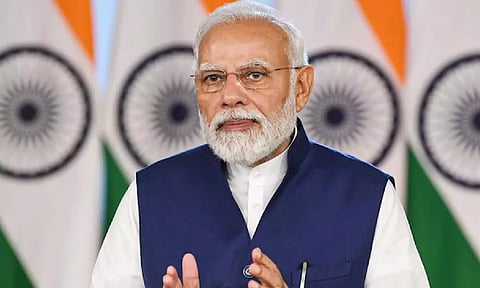

The Narendra Modi government cannot complain that its diplomatic action against Pakistan after the Pahalgam killings last month is not being well-supported by the people, the media and even the Opposition. By and large, its critics have been restrained in pointing out the security failures leading to the April 22 massacre. Nevertheless, the Modi government is intent on shutting out any narrative other than the one it wants to propagate. Accordingly, it has been banning or blocking independent YouTube channels and social media accounts that ask inconvenient questions.
Last week, 4PM News Network’s Hindi channel on YouTube was blocked by the Ministry of Information and Broadcasting under IT Rules 2021 citing the ruses of national security and public order. Its editor-in-chief Sanjay Sharma is legally challenging the block order as an attempt to silence critical journalism. In UP, the police have filed an FIR against Neha Singh Rathore, a singer who posts satirical folk songs on Twitter and Instagram. The trigger was a short poem she posted holding the government to account, which the police say is an incitement to public disorder.
Another satirical Twitter account called Dr Medusa, run by Lucknow University professor Madri Kakoti, has been slapped with an FIR for stating that Kashmiri students must be protected from the Pahalgam backlash. Her post became popular in Pakistan and went viral. The FIR against Dr Medusa is truly Kafkaesque: It says her posts might disrupt peace and harmony.
Apart from these high-profile cases, multiple regional YouTubers and independent journalists have reported content removals or takedown notices, algorithmic suppression (shadow bans, demonetisation) and warnings under the IT Rules, 2021. These accounts include independent journalists who are providing rich ground reporting from Kashmir, independent YouTubers known for anti-BJP commentary, and civil society voices questioning Indian security failures.
Alongside these actions, the Ministry of Information and Broadcasting has ordered the blocking of 16 Pakistani YouTube channels, along with the X accounts of Pakistani politicians and celebrities, including Prime Minister Shehbaz Sharif, Defence Minister Khawaja Asif, and actor Shaan Shahid. Some of these banned Pakistani channels include reputable media outlets like Dawn and independent commentators who offer balanced perspectives on the Pahalgam incident. Absurdly, several Pakistani cricketers’ accounts have been blocked too, although they post about nothing but cricket.
What comes through from this flurry of online action is the Modi government’s failure to clearly outline the criteria for banning Indian accounts. While there could be a case for blocking content by the more extreme Pakistani channels, no such case exists for the Indian accounts. Were these accounts inciting violence? Were they echoing Pakistani narratives? Or were they simply raising inconvenient questions?
In a democracy, vague accusations of "misinformation" are not sufficient to justify silencing a citizen. Transparency and due process are essential if digital regulation is to win public trust. Disinformation is a real threat, particularly in conflict zones like Kashmir. India must defend itself against information warfare. But it must do so in a manner that reinforces, not weakens, its own democratic foundations.
While national security is important, it is crucial to balance it with the preservation of democratic values, which ought to be paramount. The Modi government's actions restricting online opinion and reportage on Pahalgam undermine these values. They stifle necessary discourse and potentially will lead to a loss of public trust.