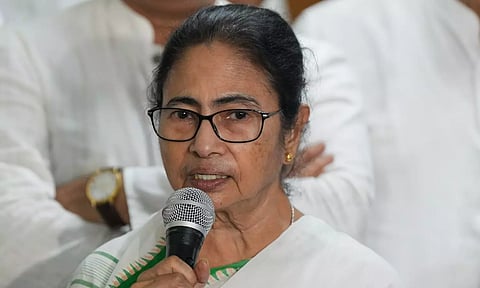

NEW DELHI: Mamata Banerjee’s speech at the Martyrs' Day rally in Kolkataon Monday, July 21, was a forceful effort to rouse Bengali pride. It indicates what her strategy will be to beat back the BJP’s assault on her bastion in the next election.
Essentially, she is resorting to a familiar template: When Delhi becomes too big for its boots, regional leaders organise identity counter-assertions, chiefly on the basis of culture and language, to cut the imperium to size.
The strategy worked for CN Annadurai in the 1960s, Akali Dal in the ‘70s, and NT Rama Rao in the ‘80s. The linguistic and cultural assertions we are currently witnessing in Bengal, Maharashtra and Tamil Nadu (and elsewhere as well) are a gathering storm and could well become the nemesis of the BJP that liberal democratic politics failed to be in the past 11 years.
Accusing the BJP-led Union government of practising 'linguistic terrorism', Mamata announced she would launch a language movement ('Bhasha Andolon') ahead of the 2026 elections to galvanise Bengalis across the country.
She is in a unique position to mount such a challenge without the risk of being labelled parochial. Invoking the many Bengalis who played a major part in the freedom struggle, she asked, “Where did Netaji Subhas Chandra Bose’s ‘Jai Hind’ slogan come from? Where did the national song Vande Mataram come from? Where did the national anthem come from?”
The BJP’s discomfiture in the face of regional mobilisation is evident in Maharashtra as well. There, the best-laid plans of the Nagpur-Pune-Konkan strain of the RSS to claim ownership of Maratha pride have been put paid to by a controversy over language policy.
A government order making Hindi the mandatory third language for Classes 1–5 has given a handle to regional parties like Shiv Sena (UBT), MNS, and NCP to paint it as an “undermining” of the Marathi identity. It also reunited estranged cousins Uddhav and Raj Thackeray and ignited a “Speak Marathi” movement targeting Gujarati and Hindi speakers.
However, it is in Tamil Nadu that the BJP’s brand of nationalism has been most effectively stopped in its tracks. Chief Minister MK Stalin remains implacably opposed to any bid to inveigle Hindi in the guise of the three‑language policy — while making it available as an elective to whoever desires to learn it.
The BJP’s Indo-Gangetic nationalism has also been dealt a setback by the Keeladi excavations, which reveal a 2,500‑year‑old Tamil urban civilisation and support the thesis of pre-Vedic antiquity of southern cultures.
This is not a spontaneous combustion. It is a response to institutional interventions by the BJP-ruled imperium that have strained the federal spirit of the Constitution. If the debate has turned fractious, the blame lies with the bid to impose a homogenised national identity, nudging aside a richer mosaic of linguistic and regional cultures.
Rather than the liberal democratic opposition represented by the Congress, it is this linguistic and cultural mobilisation being witnessed in Tamil Nadu, Maharashtra, West Bengal, Jharkhand, Manipur and Punjab that may become the main challenge to the BJP in the years ahead. It is, of course, a fractured and disparate challenge, but it could make a greater dent than conventional politics has been able to for 11 years now.