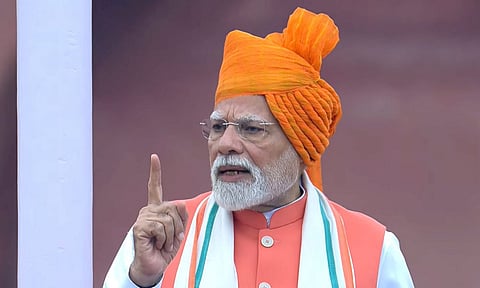

As we step into September, two birthdays should give us pause to consider whether there should be a retirement age for politicians. On September 11, RSS sarsanghchalak Mohan Bhagwat will turn 75, and a week later, on September 17, the Prime Minister will celebrate 75 years of his advent. The notion of politicians calling it a day upon reaching 75 was brought into vogue after Modi’s ascent to power in 2014, although he himself never said so. It was the BJP under his leadership that began the unofficial practice of sidelining leaders over 75 from office.
Veteran leaders like LK Advani, Murli Manohar Joshi, Sumitra Mahajan, Yashwant Sinha, and Najma Heptulla were excluded from office without spelling out the rule. Advani and Joshi were moved to the Margdarshak Mandal, a supposed advisory body that never got off the ground; the others were simply ignored. Since vanvas at 75 was never an explicit policy, it could be selectively applied. For example, 77-year-old BS Yediyurappa was made chief minister of Karnataka in 2018 when he was needed to rake in the numbers, and forced to retire in 2022 when no longer needed.
For Modi, the vanvas dictum came in handy to steer the BJP towards unapologetic majoritarianism without Vajpayee-era seniors breathing down his neck. It was an instrument, not a doctrine, for him. So, it should surprise no one now that there is no talk of him retiring on September 17. RSS chief Mohan Bhagwat did raise a few eyebrows when he said a month ago that “if you are honoured with a shawl after turning 75, it means your time is up.” He clarified last week that he was “misinterpreted” and had never said anyone should retire at that age.
Whatever Modi’s plans post September 17, there is something to be said for imparting a dash of youth to Indian politics in general, and our legislatures in particular. The present Lok Sabha, the 18th, skews higher than the global average age (53) for lawmakers. It is, in fact, the oldest lower house we have ever had. The average age of our current MPs is 56, well above the 46.5 it was in the first Lok Sabha. More than 52% of our MPs are older than 55, and only 11% younger than 40.
It is entirely anomalous that the demography of our legislatures should get older while the population at large trends younger. The first five Lok Sabhas consistently averaged below 49 while the most recent five inched up into the mid-50s. There’s been a clear upward trend since the 1990s, underscoring a significant generational stagnation in political representation.
India, in fact, has the highest gap between the median age of its legislature and the median age of its general population. The gap stands at 28 years today, compared to 20 in the US, 10 in the UK, and 8 in Japan. This gap has implications for governance and policy. Countries with legislatures that are significantly older than the population tend to be more authoritarian (as in the Arab world) and prioritise policies for older demographics such as pensions, property, and traditional business interests. Youth issues like education, employment, technology, mental health, and sexual education receive less focus or slower reform. This must explain the short shrift unemployment and falling educational standards have gotten from the present government despite plumbing alarming depths.