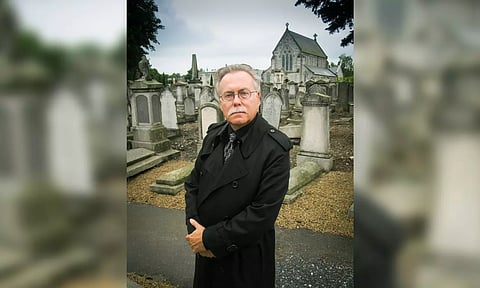

David J. Skal, a witty historian of horror entertainment who found in movies like “Dracula” and “Rosemary’s Baby” both a mirror of evolving societal fears and a pressure-release valve for those anxieties, died on Jan. 1 in a car accident in Los Angeles. He was 71.
Skal was returning home after a movie and early dinner with his longtime partner, Robert Postawko, when an oncoming vehicle crossed a median and hit their car, said Malaga Baldi, Skal’s literary agent. Postawko was badly injured but survived the crash. Skal was an author with encyclopedic knowledge of a subject not always taken seriously — movies meant to scare the bejesus out of people — whose erudition, combined with a chatty writing style, made his books lively and entertaining.
As an evangelist for horror, he was a regular guest on NPR, explicating frightful topics in a sonorous and friendly voice, and a consultant to Universal Studios for a theme park ride in Florida, “Halloween Horror Nights.” He also added commentary tracks to Universal’s DVD series of classic monster movies, from “Dracula” (1931) to “Creature From the Black Lagoon” (1954).
“One of the major functions that monsters provide for us is they let us process our fears about the real world without having to look at them too directly,” he told The New York Times in 2014.
He could riff in his writings on the cultural theories of Susan Sontag, Lionel Trilling and R.D. Laing. But his own critiques were never stuffy, grounded as they were in his personal fandom for a genre he first encountered as a boy living outside Cleveland. His first movie memory was watching “Frankenstein Meets the Wolf Man” on television. “In the blue-collar suburb I grew up in, people who didn’t have much use for Don Giovanni responded to Dracula, and Frankenstein proved a serviceable substitute for Faust,” Skal wrote in the introduction to his book “Screams of Reason: Mad Science and Modern Culture” (1998), a study of mad scientists in movies and on television.
Skal’s most influential work, “The Monster Show,” surveyed crazes for frightening films that reverberated with horrors in the real world.
His most influential work, “The Monster Show: A Cultural History of Horror,” published in 1993, surveyed crazes for frightening films that reverberated with horrors in the real world, beginning with the silent classics “Nosferatu” (1922) and “The Hunchback of Notre Dame” (1923), which appeared after the mass deaths and bodily disfigurements of World War I.
Hollywood’s horror wave during the Great Depression — which besides “Dracula” included “Frankenstein” (1931) and “Dr. Jekyll and Hyde” (1932) — reflected, in Skal’s view, terrifying economic times. The Cold War, with its fears of foreign invaders, brought such escapist frights as “Invasion of the Body Snatchers” (1956), and the AIDS epidemic of the 1980s, when society was fixated on the dangers of blood contact, was paralleled by a boom in vampire movies.
Skal’s survey offered “persuasive evidence that in order to understand a culture, you must know what it fears,” Stefan Dziemianowicz, an authority on horror, fantasy and science fiction, wrote in a review in The Washington Post.