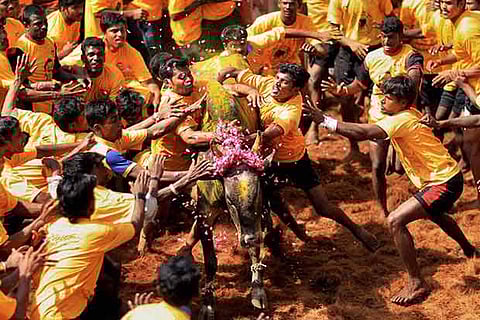

In the backdrop of the deaths of two people in Pudukkottai and Madurai districts, who were gored by jallikattu bulls, one during a bull-taming event, and another while taking a bull for a walk, we are once again confronted with the age old question of the human and humane cost of upholding tradition. Pongal finds animal rights activists and gatekeepers of culture at loggerheads on account of traditional spectacles such as jallikattu, and deathmatch-styled cock fights.
Last year, the Madras High Court allowed the conduct cock fights during Pongal, while directing the birds should not be intoxicated with alcohol and that no knives should be tied around the legs of the birds, with the tips of the blades being dipped in poisonous substances. More often than not, the rules are violated, as law enforcement officials steer clear of inflaming tensions amidst such revelries. This year, the question of safety was thrown into sharp relief in the run-up to the Jallikattu in Madurai and other parts of Tamil Nadu. Several bull tamers had voiced their opposition against a measure to fix rubber sheaths on the horns of the bulls. Though not mandatory, the covering has been recommended as a safety measure.
The tamers likened the measure to warriors being compelled to fight without weapons. The chief of the state Jallikattu Payirchi Maiyam (training association) urged all tamers to protest the move and not implement the regulation. In 2019, the Madurai district administration had announced a compulsory insurance scheme for bull tamers in case of death, while participating in jallikattu events. The tamers were instructed to mandatorily apply for insurance under the Pradhan Mantri Suraksha Bima Yojana (PMSBY) scheme. Under the scheme, a risk coverage of Rs 2 lakh was offered for accidental death. The tamers were also instructed that they would be allowed to enter jallikattu arenas in Madurai district, only if they applied for the insurance.
This year, there is no such cover for bull runners owing to which the jallikattu body has urged the government to provide the same for all participating tamers and compensation to families of tamers, who succumb. Last year, four people were killed in separate Jallikattu events in Tamil Nadu and Karnataka. On one side, the empaths believe it is pointless and inhuman to employ beasts in a thoroughly machismo-driven exercise disguised in the garb of upholding eons-old heritage. On the other end are stakeholders – farmers and youngsters hailing from rural Tamil Nadu for whom these activities are intrinsic to the question of identity and regional pride.
It’s not an isolated issue. Take for instance, the running of the bulls at the San Fermin festival in the northern Spanish city of Pamplona, which is held every year. Regardless of the opposition to the grisly fate awaiting the bulls – they are later killed by matadors (bullfighters) in arenas – the sport continues to draw lakhs of visitors from around the world.
Encouragingly, the region of Catalonia has banned bullfighting and stopped showing it to ‘protect children from seeing violence’. Opinion polls have also consistently recorded that support for the sport is dropping among Spaniards. It’s a touchy subject undoubtedly, as those involved in such sports regard any and every ‘affront’ to the conduct of such events as personal attacks. It’s hard to argue in favour of safety and animal rights when the ‘majority’ itself considers such aspects secondary to the conservation of culture.