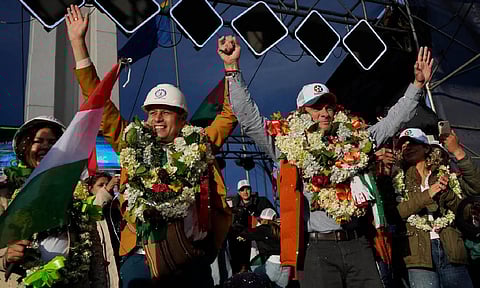

The first round of Bolivia’s presidential election Sunday signalled the end of 20 years of dominance by the governing socialist party, but a centrist senator’s surprise first-place finish upended many analysts’ expectations of a clear victory for the right.
The senator, Rodrigo Paz, had been polling near the bottom of the eight-candidate field, but preliminary results from Bolivia’s election authority Sunday night showed him leading with 32% of the vote, with 78% of the ballots counted.
A conservative former president, Jorge “Tuto” Quiroga, was in second place with 27%. The two will face each other in an October runoff election.
“Nothing has been won here,” Paz said in a speech in a La Paz park Sunday night as supporters cheered and honked car horns. “The people have given us the right, and then we will have to fight the second part honestly. The important thing is that this is a project for all Bolivians and by all Bolivians.”
Bolivia is in the midst of an economic crisis, and many voters have been frustrated with the long-governing Movement For Socialism party, widely known by its Spanish acronym MAS. For two decades, the nation’s politics have been defined by the party, led by the former union leader Evo Morales, who in 2005 was elected as the first Indigenous president of Bolivia and served for 14 years.
Sunday’s presidential election was the first since 2002 without Morales or a handpicked successor on the ballot. The outgoing president, Luis Arce of the MAS, is extremely unpopular and chose not to seek reelection. Analysts said Paz had drawn support from leftist voters who were disillusioned with the MAS but reluctant to back the right.
“This is a clear signal that people were just tired of the MAS, tired of the left,” said Gustavo Flores-Macías, a Cornell University professor who focuses on Latin American politics.
Paz cast himself as a centrist during the campaign, steering clear of polarising rhetoric, said Veronica Rocha, a Bolivian political analyst. The son of a former president, Jaime Paz Zamora, Paz has been in politics for two decades and a senator since 2020, but he was never a nationally prominent figure before now.
“He is pragmatic,” Rocha said. “He has worked with everyone but is undoubtedly opposed to the MAS.”
His campaign focused on decentralising the state and channeling more funds to regional governments. He also called for giving more Bolivians access to credit, removing restrictions on imports, tackling corruption, and reforming the justice system.
Many supporters of Paz said they were particularly drawn to his running mate, Edman Lara, a police captain who resigned publicly after denouncing corruption in the police force.
“The only option we have left, the only hope we have left, is Rodrigo Paz and Capt. Lara. Mostly because of Capt. Lara,” said Claudia Ramos, 45, a street vendor in La Paz. “The other parties are very old, very dinosaurlike, and all they want is to come to power and stay in power and steal from us.”
Lara was crucial to the campaign’s strong social media strategy, and he crisscrossed the country reaching out to voters directly, said Carlos Saavedra, a political analyst. He called Lara “a true political outsider, a man who has never been a member of any party.”
Bolivia’s flailing economy was the top issue in the election. Fuel shortages, rising prices, and a lack of access to US dollars and imported goods have provoked fury and protests over the past few years.
During his three terms as president, Morales oversaw sharp declines in poverty and poured state funds into infrastructure, schools, and health care.
But his disputed 2019 run for a fourth term triggered mass protests, deadly crackdowns, allegations of electoral fraud, and a democratic crisis that forced him into temporary exile. Arce, his ally, won the presidency the following year, but the two later split in a bitter power struggle that splintered the party. A court barred Morales from running for president this year, citing term limits.
Samuel Doria Medina, a wealthy centre-right businessperson who had been leading in the polls, finished third, according to the preliminary results. Andrónico Rodríguez, a former Morales protege and longtime MAS member, ran under the banner of a different party and finished fourth.
Quiroga was Bolivia’s president from 2001 to 2002, and he ran for president two other times. Both he and Paz have called for slashing government spending, including fuel subsidies, which were a hallmark of the MAS socialist economic model.
@The New York Times