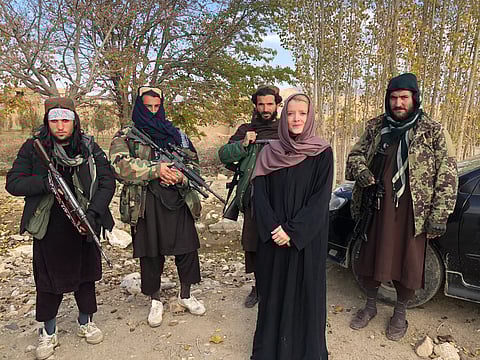

Afghanistan was the Vietnam of our era,” Jane Ferguson writes in her memoir, “No Ordinary Assignment.” She sees her generation of reporters as descendants of the men and women who covered the first war the United States lost to a largely rural Asian nation. In both cases, America had the overwhelming military advantage of a superpower’s arsenal and the political disadvantage of a superpower’s hubris.
The similarities end there. Ferguson and her 21st-century colleagues have had to navigate a world of wars far more complex and often more deadly than the ones that came before. By comparison, the war that journalists covered in Vietnam, while dangerous, resembled World War II set-piece battles.
Still, Ferguson always held her predecessors up as models. Her memoir is an engrossing chronicle of the costs and rewards of becoming like the women she saw delivering news of skirmishes and revolutions on TV. That Ferguson would become a war reporter who epitomises this era is one of the anomalies of this compelling book.
She was born on the periphery of Europe in 1984 and raised on a grim farm in Northern Ireland during the final years of the Troubles. Her Protestant upbringing was marked by passages through Army checkpoints and occasional attacks on the village police station. Her indignation over the Troubles was easier to tamp down than her feelings of fear and anxiety at home, where her father withheld his affections and her mother’s volatile anger seemed “to center around a deep hatred of her children.”
Rather than rebel with drugs or escape to the bright lights of Belfast, Ferguson concentrated her considerable energy on school and field hockey. She also sought refuge with her Aunt Fanny, who lived in a serene cottage on the nearby County Down coast. Fanny encouraged her niece’s curiosity as she pored over the memoirs of war correspondents like Kate Adie. Ferguson recalls gathering with her family to hear Orla Guerin and Moira Stuart deliver the latest from conflict zones around the world. “All the men watched and listened in a way I knew they never would have listened to me over dinner,” she writes.
After a post-college internship at the BBC went nowhere, Aunt Fanny sent Ferguson a check for $4,500 and an admonition: “Please use this for something fun.” Ferguson’s idea of fun was studying Arabic in Yemen. She landed in Sana in 2007, at the age of 23, when the country was largely at peace. Then on to Dubai, where she took a job as an assistant sports editor at The Gulf News, an English-language daily, and settled into the Emirati expat life of air-conditioned skyscrapers, chic nightclubs and luxury cars.
While on assignment at a Mazda car dealership the spell broke. Wars were being fought across the Persian Gulf. “I couldn’t hide from the reality that I was living a life I did not want to live anymore,” she writes. What happened to the young girl admiring the women who brought the news from Rwanda and Yugoslavia to her Irish living room? Ferguson drove directly to the airport, parked her Porsche and bought a ticket to Afghanistan.
Elizabeth Becker is the author of You Don’t Belong Here...
The New York Times