
NEW YORK: On Friday, someone anonymously emailed me an article from a far-right American website as supposed proof that I had killed my husband with COVID vaccines — a reboot of the same baseless narrative first pushed in the weeks following his death in late 2022.
According to mRNA vaccine conspiracists, any untimely death or health affliction since the pandemic is because of the COVID mRNA vaccines, often linking unrelated medical events to vaccination without any evidence.
My husband died from a ruptured aortic aneurysm; his condition had no connection to COVID vaccines. Autopsy results confirmed that. But in the conspiracist worldview, any such event can be folded into the narrative.
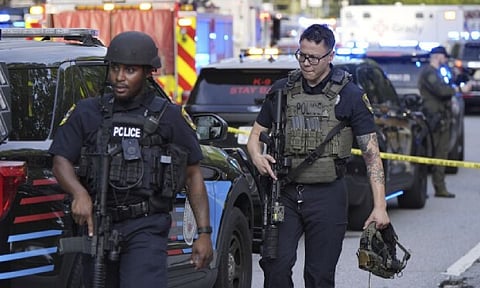
At the time, I didn’t realise the email foreshadowed what would come later that day: news of a shooting at the Centres for Disease Control and Prevention headquarters in Atlanta. The gunman was reportedly fueled by COVID-19 vaccine conspiracy theories and blamed the vaccine for his depression.
The attack left both himself and a law enforcement officer dead, and CDC buildings riddled with bullet holes. The symbolism could not be clearer: Scientists, doctors, public health officials, and law enforcement officials — people whose life’s work is to protect the nation — have targets on their backs. The CDC union has asked federal officials to condemn vaccine misinformation, since it is putting lives at risk.
Public health in America has always been divisive because it sits at the intersection of science, government authority, personal freedom and economic interests — subjects Americans have long debated fiercely. From smallpox quarantines in the 1800s to seatbelt mandates in the 20th century to COVID restrictions in our own time, public health demands collective action in a society deeply attached to individual liberty.
Public health measures, including vaccine mandates, can disrupt the economy and family life, as well as challenge cultural norms — pressures that can drive people apart, as they did during the pandemic. They can be especially contentious when blame is assigned along partisan or cultural lines.
COVID vaccination has become tribal.
On social media, one far-right American political activist claimed the COVID vaccines have “killed many, many people” and predicted more deaths to come. Pro-vaccine commenters have mocked and insulted vaccine-skeptical people, reinforcing the perception that the vaccine debate is as much about identity and status as it is about evidence or health.
That dynamic was evident throughout the COVID pandemic. Public officials and experts across the political spectrum often failed to explain the values and trade-offs behind their decisions. During the pandemic, and as a member of the Biden administration’s COVID-19 Advisory Board, I talked about “following the science”.
I explained that this meant recommendations might change as new evidence emerged. But I could have been clearer that prioritising saving lives could mean sacrificing other social and economic goods, and that such trade-offs were unavoidable in a crisis of that scale. I was speaking about these choices by May 2020, but the pandemic response had already hardened along partisan lines.
Misinformation about COVID vaccines is circulating online — and is even being spread by the federal government — in part because science was treated as the only source of truth during the pandemic, rather than one important tool alongside lived experience, context, history, culture and values. That misunderstanding has left science vulnerable to being twisted for political ends, and two of the most powerful people shaping health policy right now are doing just that.
For President Trump, it’s meant sidelining politically inconvenient information: from dismissing mortality data in Puerto Rico after Hurricane Maria, to claiming the country was over-testing for COVID in early 2020, to firing the head of the Bureau of Labour Statistics this month.
For the health secretary, Robert F Kennedy Jr, it’s about changing the gatekeepers and redefining what counts as credible: overhauling the CDC’s vaccine advisory board, potentially planning a similar overhaul of the US Preventive Services Task Force and waging war on mRNA vaccines and the field of infectious diseases. Trump administration rhetoric has dehumanised CDC workers.
Science is a method for formulating and testing hypotheses, not a fixed set of facts. It should work alongside other ways of knowing, but it must also be protected from political or commercial capture. Perhaps I’m naïve to think that such preservation is possible, but when it fails, people manipulate facts, trust collapses and public decisions lose their anchor in a shared understanding of reality. This undermines the very goals of public health policy, which is meant to be a collective endeavour.
It should not be partisan to say that political violence is wrong, that corrupting science and manipulating data is wrong and that public service is patriotic. Restoring that shared base line — and protecting the institutions, people and processes that make it possible — is the only way to safeguard both the health of the public and the health of our democracy.
(Céline Gounder is an infectious disease specialist and epidemiologist at the NYU Grossman School of Medicine and Bellevue Hospital Centre)
c.2025 The New York Times Company